



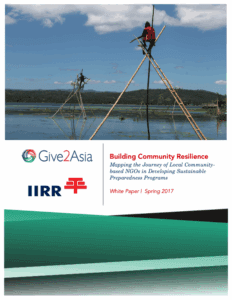
Mapping the Journey of Local Community-based NGOs in Developing Sustainable Preparedness Programs
This white paper, the second in a series by Give2Asia and the International Institute of Rural Reconstruction (IIRR), explores how local organizations across Asia are building sustainable community resilience in the face of escalating natural disasters. Drawing lessons from events such as Typhoon Haiyan in the Philippines, the report underscores the urgent need to shift from costly, reactive disaster relief toward proactive investments in disaster preparedness and risk reduction.
The introduction highlights the mounting pressures vulnerable communities face from climate change, poverty, urbanization, and food insecurity—factors that amplify the impact of natural hazards. Despite growing evidence that resilience-building is cost-effective, funding for disaster risk reduction remains disproportionately low compared to relief efforts. For example, low-income countries have received hundreds of times more in disaster relief than in preparedness funding.
 The paper advocates for integrating resilience into broader community development, positioning it not as a temporary “buzzword,” but as a long-term strategy to reduce losses and safeguard livelihoods. It identifies three critical questions for donors and practitioners:
- Where do we begin in building resilience?
- What models already exist across Asia?
- How do we measure success effectively?
Give2Asia and IIRR engaged with 140 organizations across six high-risk countries—Bangladesh, India, Indonesia, Myanmar, the Philippines, and Vietnam—to answer these questions. The report synthesizes their experiences, offering insights into innovative approaches, persistent challenges, and pathways forward. By centering local NGOs and community-driven strategies, it provides a roadmap for donors, corporations, and philanthropies to invest more strategically and sustainably.
Ultimately, the report emphasizes that empowered local communities—supported by targeted international investment—are key to reducing disaster losses and preparing for a future of increasingly frequent and intense climate-related events