


An examination of two emerging support models and how they are addressing these challenges in a rapidly evolving, post-COVID economic landscape.
Small businesses are the backbone of South Korea’s economy, representing 99% of all enterprises and employing more than 80% of the workforce. Yet despite their central role, many micro, small, and medium-sized enterprises (MSMEs)—particularly those led by women, youth, and underserved communities—face persistent structural challenges, including limited access to financing, uneven social protections, and widening labor market disparities.
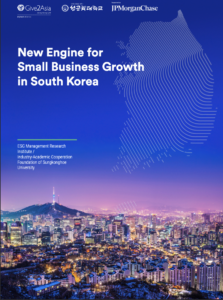
This report, developed by Give2Asia Hong Kong SAR with support from JPMorganChase and the ESG Management Research Institute / Industry-Academic Cooperation Foundation of Sungkonghoe University, examines how two emerging support models—the Entrepreneurial Support Organization (ESO) model and the Digital support model—are addressing these challenges in a rapidly evolving, post-COVID economic landscape. Drawing on surveys, focus group discussions, and case studies from leading nonprofit and ecosystem actors in South Korea, the research provides one of the first comprehensive assessments of nonprofit-funded entrepreneurship support programs in the country.
The ESO model offers a holistic, high-touch approach—combining training, mentorship, funding access, and ongoing support—which has driven strong outcomes in business growth, community impact, and the empowerment of marginalized entrepreneurs. In contrast, the Digital support model leverages online platforms to expand access to resources, attracting a broader and more diverse pool of first-time participants, and demonstrating flexibility during the COVID-19 pandemic. However, while the ESO model faces challenges related to scalability and resource intensity, the Digital model’s more generalized approach can limit its ability to deliver tailored, in-depth support.
The study finds that neither model alone is sufficient to meet the diverse needs of South Korea’s MSME sector. Instead, it highlights the potential of a hybrid approach—integrating the ESO model’s personalized, comprehensive support with the Digital model’s accessibility and reach. Such an approach could strengthen the overall ecosystem, enabling more inclusive and resilient pathways for entrepreneurship across regions and demographics.
Key recommendations include improving coordination between support providers, expanding awareness and adoption of digital tools, addressing resource constraints within ESO programs, and developing more robust systems for measuring impact. As South Korea navigates demographic shifts, economic uncertainty, and increasing inequality, these insights offer a roadmap for policymakers, philanthropic partners, and ecosystem builders seeking to foster sustainable, inclusive growth through entrepreneurship.